

Pay attention to our latest news and exhibitions.


Article Directory
- 1 What an OEM rubber seal strip production workflow looks like
- 2 Material choice: EPDM versus PVC in custom sealing
- 3 Hardness and tolerance: the specifications that prevent rework
- 4 Quality control to verify before mass production
- 5 Secondary operations and construction variants
- 6 A practical checklist for your next OEM seal strip order
A regional window manufacturer takes on a new tilt-and-turn window line, and the first question that reaches the sourcing desk is not about aluminum extrusions. It is about the rubber seal strip: EPDM or PVC, what hardness, what cross-section tolerance, and whether the factory can reproduce the profile from a simple drawing within the project lead time. For most OEM rubber seal strip projects, the outcome is decided long before the extrusion line starts — by the material selection, the dimensional specification, and the quality system behind the quotation.
The short version of this guide is simple: a successful OEM rubber seal strip order does not depend on finding any supplier that can extrude rubber. It depends on a partner that controls its compounds, holds realistic tolerances, and documents quality at each production stage. An experienced sealing strip manufacturer can turn a rough sketch or a worn sample into a tested production profile, but only if the buyer supplies the right technical input.
What an OEM rubber seal strip production workflow looks like
Every custom seal strip order follows the same route: drawing or sample review, compound selection, tooling, extrusion and vulcanization, finishing operations, sample approval, and finally serial production. The risk concentrates in the early steps, and a manufacturer that skips them will produce a profile that fits the machine but not the customer's window frame.
An OEM partner with in-house engineering and tooling capability, such as Fortex (Shanghai) Industrial Co., Ltd., can review the drawing, recommend a compound, and prepare tooling before committing large quantities of material. With an annual capacity of more than 20,000 tons and export experience across Europe, America, and Japan, a manufacturer of this type can scale from pilot samples to serial deliveries without changing the process. The typical sequence is:
- Drawing or sample review, including the groove width, compression ratio, and how the seal will be installed.
- Compound selection, choosing dense or sponge EPDM, PVC, or a custom formulation matched to hardness and temperature requirements.
- Die and tooling preparation, machining the extrusion die and setting up the vulcanization or foaming line.
- Extrusion and vulcanization, where the profile is shaped and cross-linked; sponge profiles cure to the required density in this step.
- Secondary operations such as acrylic self-adhesive backing, fin lamination, flock application, cutting, and splicing.
- Sample verification, measuring dimensions, hardness, and surface quality against the approved drawing.
- Serial production and inspection, using in-process gauging and final sampling based on AQL procedures.
The sequence matters less than the discipline. Buyers who order "something like this sample" without a drawing accept a high degree of interpretation risk. A manufacturer that exports to demanding markets, operates under ISO9001, and maintains its own test laboratory will normally insist on a written specification, because that protects both sides.
Material choice: EPDM versus PVC in custom sealing
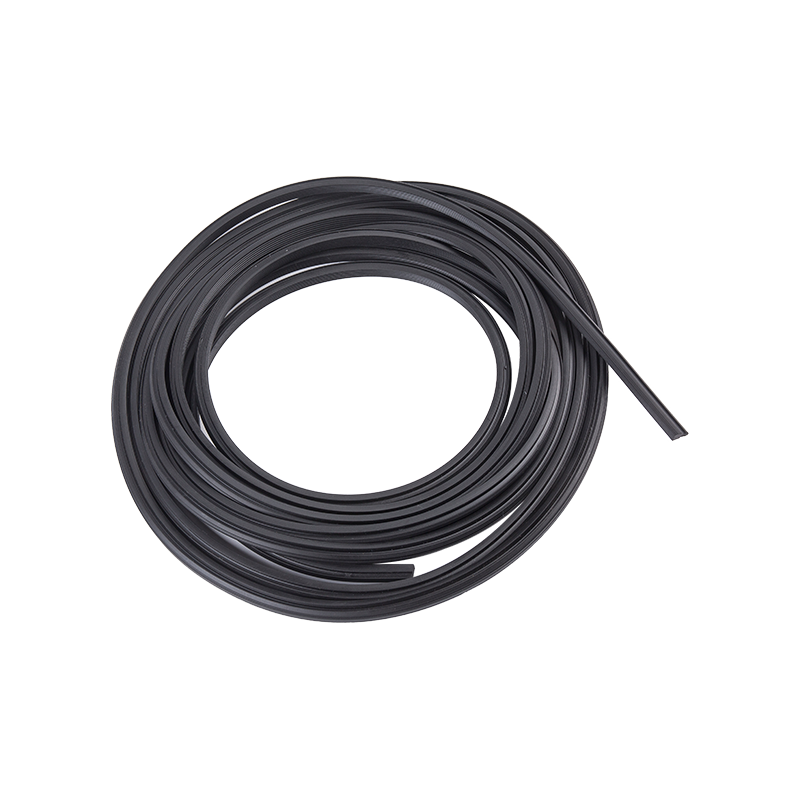
The most common material debate in an OEM seal strip project is EPDM against PVC, and for exterior door and window seals the answer is usually EPDM. Ethylene-propylene-diene monomer rubber resists ozone, ultraviolet light, and temperature swings better than most general-purpose sealing materials, which is why manufacturers specify it for perimeter seals, glazing gaskets, and stationary-window applications.
Why EPDM dominates exterior OEM seals
EPDM performs consistently from roughly -40°C to +120°C, recovers well after sustained compression, and stays flexible in winter conditions. For projects that face strong sunlight, coastal salt air, or cold climates, EPDM provides a defensible product warranty. Foam and sponge EPDM grades reduce the closing force on lightweight sashes and sliding panels, while dense EPDM gives the stable edges that a groove seal needs.
For a first custom profile, an EPDM foam rubber sponge sealing strip is often the fastest way to test both groove fit and closing force before the design is frozen.
When PVC profiles are the better call
PVC rubber strips remain relevant when the project needs abrasion resistance, chemical resistance, or a budget-friendly dense profile for interior work. PVC is easy to cut and trim, holds its shape well, and provides good insulating performance. The trade-off is lower cold-weather flexibility and a higher tendency to take a permanent set under heavy, sustained compression compared with vulcanized EPDM.
| Property | EPDM | PVC |
|---|---|---|
| Usable temperature range | about -40°C to +120°C | about -20°C to +70°C |
| Ozone and UV resistance | Excellent | Good |
| Compression recovery | Low compression set, good recovery | Moderate; may take a set under heat and load |
| Hardness options | Dense 40-80 Shore A plus soft sponge grades | Dense profiles, generally firmer feel |
| Typical OEM applications | Exterior door/window seals, glazing gaskets, automotive fixed-window seals | Interior weather seals, dust and insect barriers, budget glazing profiles |
| Relative material cost | Higher | Lower |
The table simplifies, but it reflects the way OEM buyers usually decide. A fixed glazing profile in a protected frame may work well with PVC; a movable sash exposed to winter wind and summer UV should be EPDM.
Hardness and tolerance: the specifications that prevent rework
Hardness is the most misunderstood specification in an OEM seal strip order. Dense EPDM seals for window and door frames typically sit between 55 and 70 Shore A; a profile that must compress under a lightweight sash should move to sponge EPDM or a lower-durometer dense compound. If a buyer asks for "very soft rubber" and "dimensional stability" at the same time, the supplier should explain the trade-off between softness and shape retention.
Dimensional tolerance is the second most common cause of rejection. Extruded rubber is not machined metal. For a small critical dimension, such as the width of a locking lip or the depth of a groove-engaging rib, a practical OEM target is about ±0.2 mm to ±0.3 mm. Larger, non-functional dimensions can run to ±0.5 mm, especially on soft or sponge profiles. Expecting ±0.05 mm on a flexible EPDM profile is unrealistic and will raise tooling and inspection costs without improving the sealing result.
For practical ranges on real profiles, our guide to choosing the right EPDM dimensions, hardness and profile shape explains what a manufacturer can guarantee before tooling is cut.
Beyond geometry, ask the manufacturer which compression set test they run and under what conditions. A seal that does not return to its original height after years of being squeezed will let air and water pass, no matter how clean the profile looks on a drawing.
Quality control to verify before mass production
An OEM order is only as reliable as the inspection system behind the extrusion line. The factory's own laboratory should measure cross-section dimensions, check hardness with a durometer, verify density on sponge profiles, test adhesive peel strength on backed products, and compare production samples with the approved drawing. These checks are standard inside an ISO9001 quality management system, and specified products can be supported by third-party SGS test reports when the contract requires them.
Laboratory checks that matter
- Cross-section dimensional measurement against the approved drawing.
- Hardness testing on dense profiles with a Shore A durometer and soft sponge profiles on the appropriate foam scale.
- Compression set testing at the specified temperature and duration.
- Peel adhesion testing for self-adhesive backing.
- Visual inspection for surface defects, flow marks, and color consistency.
Documents and certificates
Buyers in Europe, the United States, and Japan usually request a quality certificate with each shipment plus test reports for key performance properties. A manufacturer that exports roughly half of its output, as Fortex does, is familiar with these requirements. The critical step is to write the terms before sampling: which tests, which limits, and which certificates.
For engineered details on complex profiles, our article on custom EPDM rubber strips in engineering applications covers design considerations that most buyers discover only after the first rejection.
Before approving a supplier, review the professional buying tips for high-quality EPDM rubber strips; the checklist matches what a sourcing engineer should prepare before quotation.
Secondary operations and construction variants
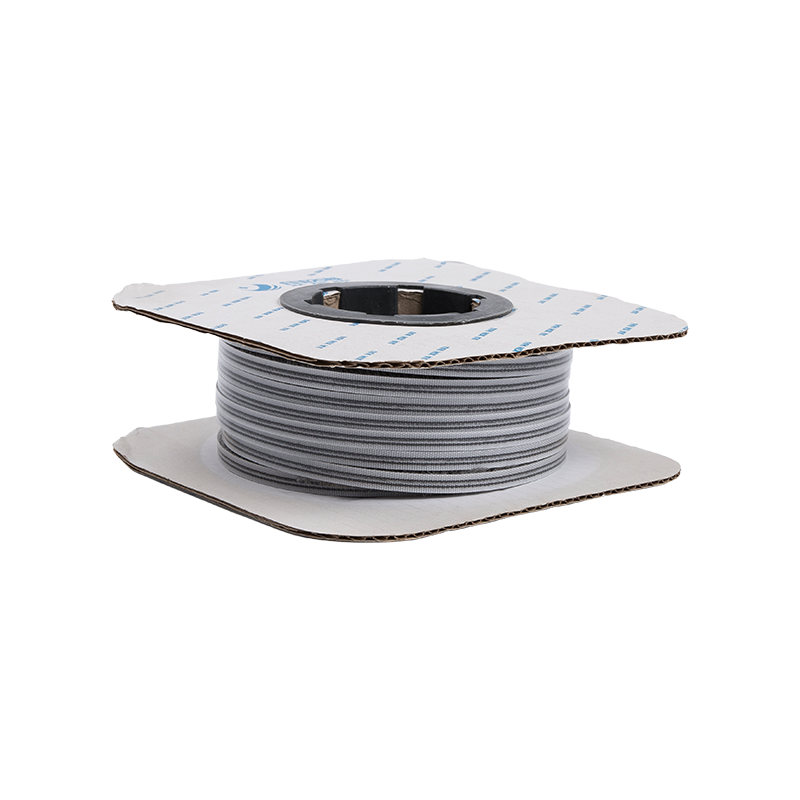
The extruded cross-section is only part of an OEM seal strip. Many projects include a secondary operation: an acrylic self-adhesive backing for fast installation, a fin that controls airflow and dust, siliconized pile for sliding windows, or hot-melt laminated wool pile for a narrow channel that will never be adjusted again.
When a client wants peel-and-stick installation, a high-density self-adhesive backing EPDM door seal removes glue application from the assembly line and keeps installation time predictable.
Finned and brushed profiles work where a solid rubber seal creates too much friction, such as sliding doors that must move easily while still excluding dust and noise. Siliconized brush pile and wool pile strips cover that niche, while ribbed foam EPDM profiles handle glazing channels that need compressible sealing without adhesives.
Where a dense, cost-controlled profile is acceptable for interior work, a high-tensile-strength embossed PVC window sealing strip offers the rigidity that certain fixed-frame installations require.
The same OEM supplier can also combine seal strips with related door and window hardware such as rollers, hinges, locks, and screens, which simplifies logistics and keeps dimensional responsibility with one factory.
A practical checklist for your next OEM seal strip order
- Send a dimensioned cross-section drawing, or a physical sample plus the groove width and depth of the frame.
- State the installation method: slot-in, self-adhesive, staple, or hot-melt.
- Define the operating environment: temperature range, UV exposure, humidity, and chemical contact.
- Specify hardness, allowed tolerance, and compression set expectations.
- Confirm which certificates and test reports each shipment must carry.
- Agree on the approval process for first samples before tooling payment is released.
OEM rubber seal strip production is a collaboration of measurement and material knowledge. The buyers who get the best results bring a clear specification, a realistic tolerance budget, and a supplier willing to challenge wrong assumptions. Everything else is routine, provided the routine is built on proper drawing review, compound selection, and documented quality control.